Showing posts with label handspun. Show all posts

Saturday, March 31, 2012

It Wasn't Hard at All *

In my last post, I showed you my freshly spun Bamboo/Merino/Bison/Cashmere yarn and talked about my dissatisfaction with the natural color.

I considered the color selection in Dharma Trading Co.'s acid dye, decided on Alpine Blue, and placed my order. I dug an old enameled stock pot out of the back of the cupboard, bought a cheap package of wooden spoons at Big Lots, and found my bottle of white vinegar.

A smarter woman would have done some experimenting first.  A more cautious woman might have practiced the process with some inexpensive commercial yarn, or wound off a small sample of the handspun for a color test.

I took time to read the instructions on Dharma's website, but then I threw caution to the wind.  I put my skein in a bowl of warm water to soak. I filled my stock pot and put it on the stove. I weighed out some dye powder, dissolved it in some hot water, and added it to my stock pot. I turned on the heat, added my wet yarn amd gave it a good stir. When the temp was just to simmering, I added a splash of vinegar, then let the pot simmer for 30 minutes. Then I pulled out the yarn and gave it a good wash and several rinses.
The Patron Saint of Reckless Women was smiling on me.

Want to see the results?
This...
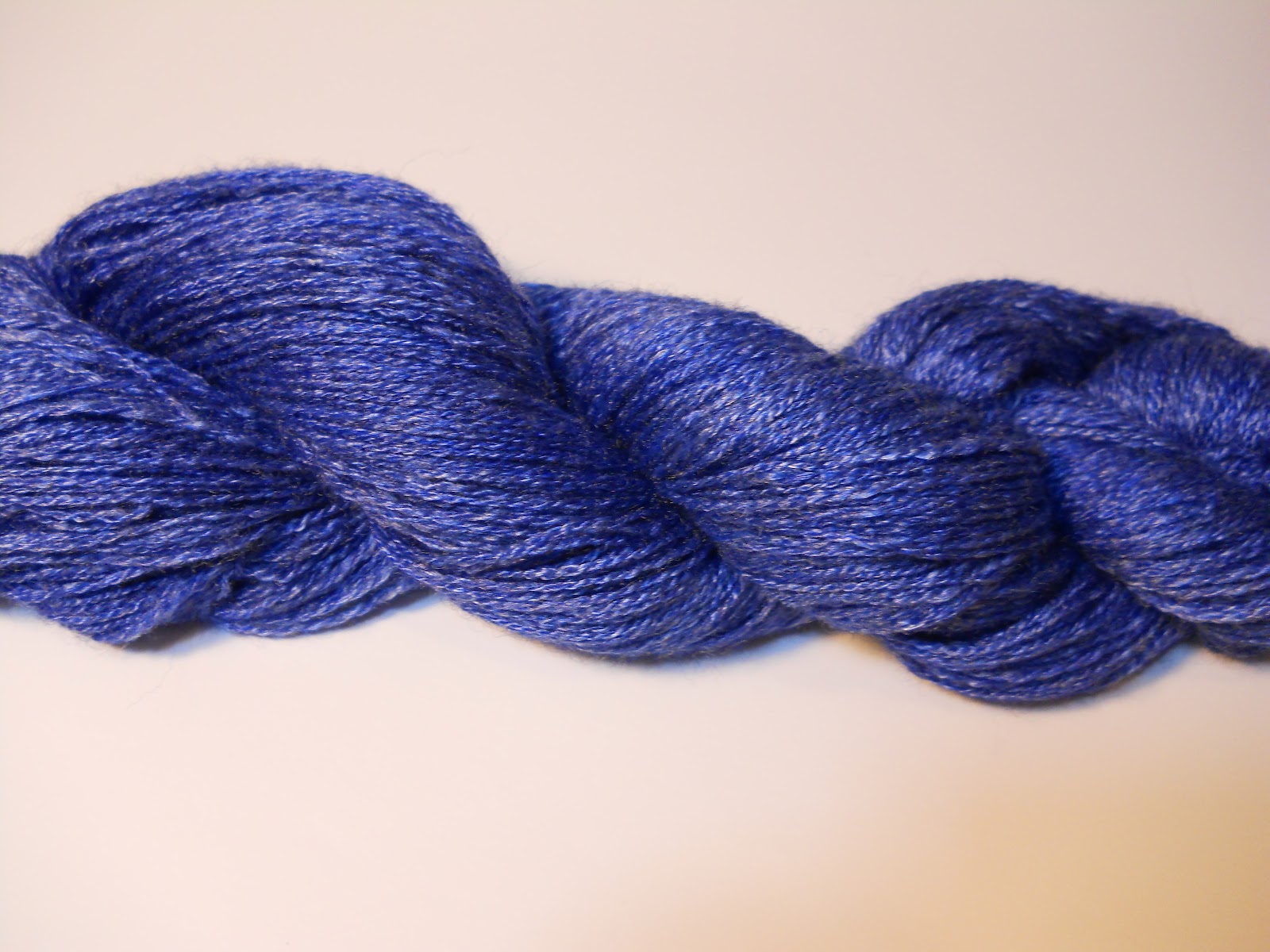
 turned into this..
.
I love the new color.  As expected, the bamboo did not absorb the dye the same way the wool, bison and cashmere did. It shines through as a paler shade of blue. The softness, sheen and drape I loved in the original yarn is still every bit as seductive.

Lessons learned:
  1.  I used far too much dye. The manufacturer recommended 1/4 oz for each pound of fiber. Since my skein was 2 oz, I figured I needed just under 1 gram of dye.  My digital kitchen scale really isn't accurate at such small quantities, so I can't be sure exactly how much I used. What I didn't account for is the bamboo.  It was 50% of my fiber blend. As a cellulose fiber, it does not take acid dye well, so I was really only trying to dye 1 oz of protein fiber. There was still lots of color left in my pot, so I know I did not exhaust the dye bath. Instead of pouring it down the sink, I poured it into mason jars.  I just can't bear to waste it (even though it's only about 50 cents worth of dye). I'm thinking I'll dig around the stash for some white wool to throw in.  Does anyone have any experience with re-heating a dye bath?  Am I asking for trouble here?
  2.  If I'm going to do much more dying, I need to get some rubber gloves.  The yarn needed lots of rinsing to get rid of excess dye - I'm guessing the bamboo was shedding the dye that was just on the surface and not bonded to the fiber. All that time in warm tinted water turned my hands a bit blue and softened my fingernails.
  3.  Fortune favors the brave. I'm so pleased with the results of this adventure.  I'm glad I didn't wimp out and decide to live with the original color.
* I almost changed the title of this post.  Instead, I'll just say to both my brothers, "Get your mind out of the gutter."

Thursday, March 22, 2012

How hard can it be?

Five little words. Fourteen letters and a punctuation mark. How hard can it be? is the first step on a road that can lead to great triumph or epic disaster. Legend has it that these words were spoken when Alexis Xenakis, Elaine Rowley, and David Xenakis started Knitter's Magazine, launching the empire that has become XRX, Inc. Of course, the question has also led to many a house burning down as the result of an attempt to deep fry a Thanksgiving turkey.

I just finished spinning this...
Just over 350 yds of fingering weight 2-ply. The fiber is 50% bamboo, 30% merino, 10% bison and 10% cashmere from Louet which was given to me as a gift.

I love it. It is gorgeous. The bamboo gives it sheen, a cool hand and limpid drape, while the bison and cashmere make it soft like a kitten. It is conspicuously handspun, but not lumpy. It begs to be a delicate lace shawl or scarf.

There is only one problem: the color. The natural chocolate brown of the bison down makes the yarn a taupey beige.  Beautiful, but not a color that is flattering next to my face, unless skin the color of oatmeal is a new fashion trend I've not heard about.

I'm thinking about dyeing this yarn, maybe a rich sapphire blue. The problem is I've never done any dyeing. I feel a bit of trepidation. What if I screw it up? Could I destroy everything that is lovely about this yarn in the process of trying to alter the color?

But after all, lots of people dye yarn at home. Many even make money doing it. They can't be that much smarter than I am.

How hard can it be?

Wish me luck. I'll keep you posted.

Tuesday, March 13, 2012

A Tale of Two Sweaters - Part 2

A couple of months ago, I told you about the CVM/Romeldale fleece my friend Diane and I bought at the California Wool Festival. I showed you the wool when it came back all clean and fluffy from Morro Fleece Works. It's time for an update.
I finished spinning my half of the fleece last week.  I ended up with just over 2100 yards of yarn.  It is soft and springy and I an quite enamored.

 What's interesting, though, is how Diane and I have taken the same raw material and come up with two very different results.
In the middle is a staple length of the wool, ready for spinning. On the left is my yarn. On the right is Diane's. I spun a very airy woolen single with minimal twist, then made a 4-ply. With washing, the plies have fused into a lovely, cohesive yarn that knits like a dream. Diane spun a much smoother single, then plied it with a natural brown merino. The merino is slightly lighter in color than our CVM, and the 2 plies are much more clearly defined. Her yarn is also soft and elastic, but has a smoother surface, producing better stitch definition in the finished fabric.
Diane is knitting a gorgeous seed stitch pullover with staghorn cables. Sorry, no link to a pattern. Diane is designing this for herself, because that's how she rolls. You can see how her choice of yarn structure produced a cable that is crisply defined against the background texture.

My yarn is destined to make Crane Creek.
See how my woolen spun yarn makes a blurrier, less defined texture?
I'll show you both sweaters when they are done, but it may be awhile. Diane is nearly finished with hers, with only a sleeve and a half to go. My Crane Creek has not progressed past the swatch stage, and is likely to remain on hold for a while. I came back from Stitches West with tonnage of yarn for new design commissions (hooray!), so personal knitting is on the back burner.


Thursday, January 19, 2012

A random collection of images and thoughts

1. Here is another new design. Yes, I was busy last fall.
This is the Lincoln Logs Blanket, made out of Riveting Worsted.  This yarn is the heavier version of Kollage Yarns popular Riveting, made from recycled blue jeans.

The blanket is worked in modular squares.  The sample shown in 9 squares - just perfect for the kids in the back of the car. The yarn is soft, and durable and machine washable, so you won't mind if the Icee gets spilled, or if the blanket falls out of the car in the parking lot. For the couch at home, I'd make the throw with 16 squares.


Find the pattern at Kollage Yarn's website, or on Patternfish.


2. I finished a pair of socks for me. These have been on the needles for over a year, as a pick-up-and-go project. The pattern is just a basic sock, with the leg worked in alternating panels of stockinette stitch and seed stitch, each 3 stitches wide. The yarn,  however, is anything but ordinary.  It is Saki from Prism Yarns, a superwash merino and nylon blend in a color called Ember. The toasty, caramel brown tones look good enough to eat. Even better, look what Laura Bryant put on the back side of the label:


Don't you just love little surprises like that?


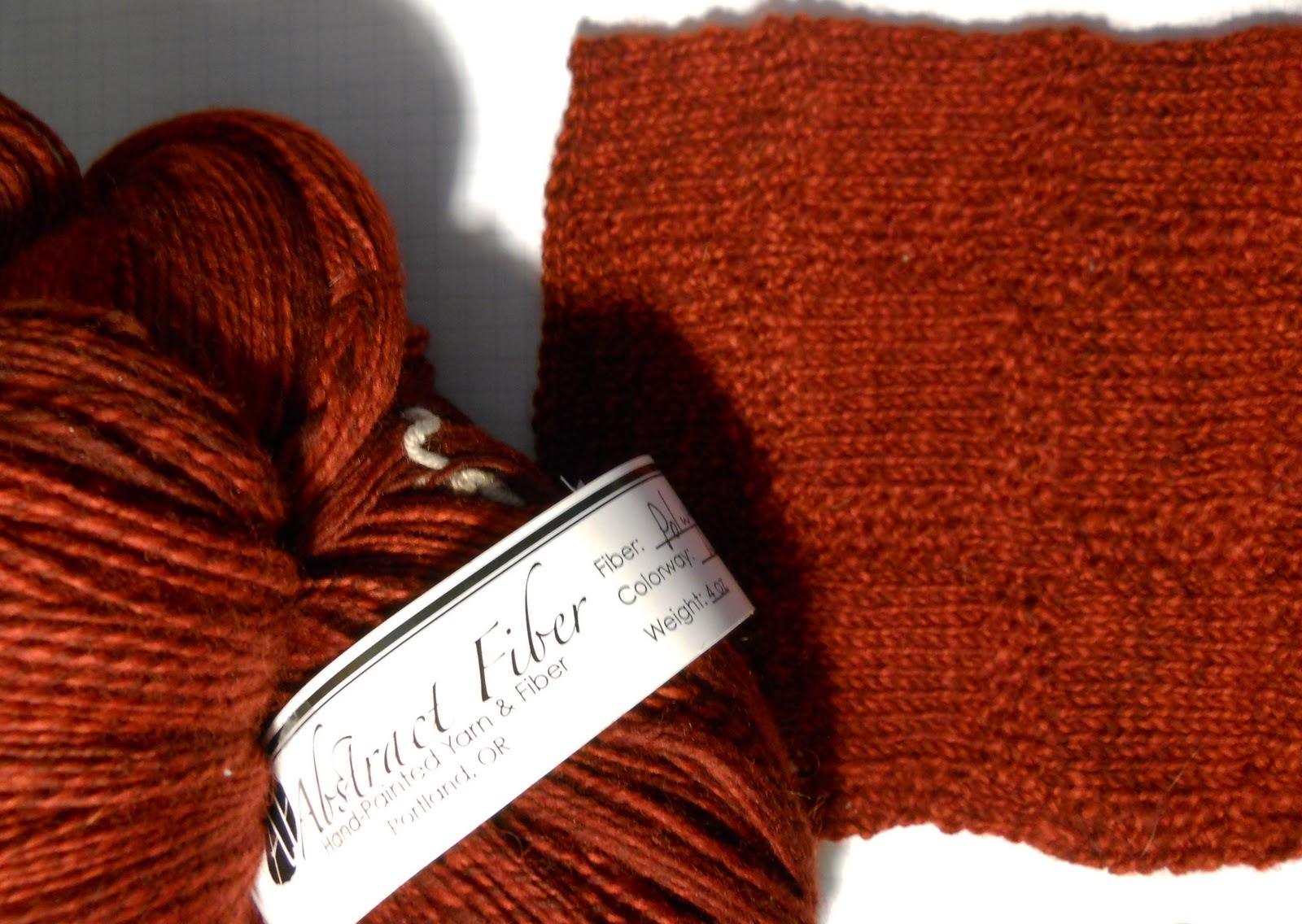
3. I've started another sweater out of handspun yarn (hooray!). This is Polwarth from Abstract Fiber. The top was dyed the most gorgeous blood red shade.  It looks rustier in this photo than it does in life.
I spun it as a 2-ply, and I'm getting about 5 3/4 sts to the inch.
This will be a simple pullover - boxes of stockinette stitch divided by bands of seed stitch.  Are you sensing a theme here? I do love the combination of stockinette and seed stitch - such a simple, elegant texture.

4.  If you had told me the 49ers would beat the Saints in a shoot out, I'd have said you were crazy.  I knew the Niners could win, but I thought it would be a low scoring game. Ha! Most. Exciting. Football. Game. Ever.
And I was certain the road to the Superbowl would go through Lambeau Field.  Yet here we are, three days away from a Championship game at home against the New York Giants. I don't know if I can stand it. Go Niners!

5. A bit of a rant. I've had a several opportunities in the past couple of weeks to be in a waiting room with the general public. In three cases, there were women in the waiting room accompanied by small children in varying numbers. In all three cases, the women spent the entire time occupied by their cell phones, while the children had no diversion at all. Why would you expect a small child to sit quietly without entertainment, when you are apparently unable to do so yourself?  Now I'm not saying every kid needs a cell phone of their own (God forbid). But a deck of cards? Paper and pencil? A book, for heaven's sake? Before my son had a Game Boy, we had activity books with mazes and dot-to-dot and word search games to play. Are such things obsolete?
That is all.

Friday, January 13, 2012

Another new design, and The Knitter's Nightmare, Vol. 2

I want to show you another new design from Kollage Yarns Spring collection.
This is Christa.

Christa is an example of a design that was inspired by the properties of a particular yarn.  Kollage Yarns Milky Whey is a blend of 50% milk fiber and 50% soy.  It is soft and smooth and slinky, and feels wonderfully cool against the skin. Like many non-wool yarns, Milky Whey has little elasticity. As a result, it tends to grow. It will grow when you wash it, and it will grow when you wear it. This is just one of those characteristics that comes with the slinky in yarn. Ever knit with 100% silk? Same issue.
I wanted to make a non-shawl garment that would not suffer from the effects of gravity.  I wanted something where the drape and flow and slink of this yarn would be used to best advantage. Christa is the result.

This is a draped front vest. Made in one piece from the bottom up, it has a curved lower edge (I never know what to do with the long points at the front of most draped front sweaters). It is made with an interesting textured stitch that looks good from both the right and wrong side, so you don't have to fuss with arranging the drape.
The collar is integrated into the piece so the flow is not interrupted.
You can wear Christa open as shown or close it with a shawl pin or brooch. I think it would also be interesting worn belted.
For a pdf download, go to Patternfish. For a hard copy, order directly from Kollage.

Nightmare Vol. 2
The handspun sweater is finished. Buttons are attached and everything.  It is soft and warm and weightless. I've been wearing the sweater for the past 2 days and I love it. Except...

The sleeves are too long. No joke.

How much to long? This much.

How did this happen? I know how long my arms are. They have not gotten shorter. My row gauge is exactly what my notes say it should be. How is it possible that I have 2" too much sleeve?

I think surgery is needed. Stay tuned for detailed how-tos. Because my nightmare might as well be a "teachable moment" (lord how I hate that phrase), right?

Saturday, January 7, 2012

From Sock to Sweater, and the Knitter's Nightmare

Kollage Yarns has released another of my designs for Spring, the Lacy Cable Tee.
This design began with a sock pattern I did for Kollage a couple of years ago. Diagonal lace panels are separated by loop cables for a sock that is delicate, yet sturdy. It is interesting to knit, but not particularly difficult. The yarn is Luscious, a cotton and elastic blend that gives great stitch definition.  This yarn is also a great pick for kids, or for those who don't wear wool.

We liked the socks so much, we decided to use the same stitch patterns for a women's summer top.

I get a big kick out of graceful transitions from one stitch pattern to another, so the cables flow organically out of the ribbing at the lower edge. The lace panels are arranged symetrically, forming a series of V-shapes along the transition line. This is a frankly feminine top that would be flattering to many women.

The pattern is available for sale now.  If you like a hard copy, you can order from Kollage. If you like a pdf download (because who doesn't want to have their knitting patterns on their iPad?), you can buy one through Patternfish.


In other news, this week I suffered the knitter's nightmare. You know, the one that keeps you up at night, that makes you break out in a cold sweat. I ran out of yarn.
I wrote a while back about the cardigan I was making for myself our of my handspun. In order to make steady progress, but not neglect deadline projects, I've allowed myself to work on the handspun sweater only during 49er games.  I've enjoyed working on it, but as I began the sleeves, I started getting that nagging worry about my yarn supply.  As I started the second sleeve, I knew it was a pretty good bet I wasn't going to make it.  Sure enough, I ran out of the darkest of my three yarns just before the sleeve cap on the second sleeve.

I don't have any more of the Romney fiber I used to spin the yarn, nor do I have information on the source that would allow me to order more. I could go on a search for more fiber in this particular not quite black color. Or I could go looking for a commercial yarn that was close enough to my 2-ply handspun to pass.  After all, we're talking about less than 25 rows in a sleeve cap, in a stitch pattern that will help disguise any inconsistency in the yarn.

I'm not so much of a purist that using a commercial yarn instead of handspun will spoil the sweater for me. A stash dive produced a ball of Aran weight shetland wool in "natural black", which is just barely darker than the Romney in my sweater. The shetland is quite a bit thicker than my yarns, so I split the 2 plies and used it as a single. I finished the sleeve with the substitute yarn.  Can you see the difference? Neither can I.

I know lots of knitters who go crazy about issues like this.  They would search high and low for fiber which was an exact match.  Failing to find it, they may abandon the project. If they do finish the project, God help you if you compliment them on the sweater.  They feel compelled to point out the imperfection to every passerby.
I have a rather high tolerance for imperfection. I just wanted to finish the sweater so I can wear it.  I will not show you where the yarn changes, even if you ask.  If you happen to see me wearing the sweater, and somehow see the line where the yarn is different, please don't mention it.

Monday, September 19, 2011

Adventures at the Wool Festival

I took a day off from the computer yesterday to go with Diane, my good friend and spinning mentor, to the California Wool and Fiber Festival at the Mendocino County Fair.

Now this is not a Wool Festival on the scale of Maryland Sheep and Wool or Rhinebeck. CWFF is held in Boonville, a tiny town in the middle of nowhere the Anderson Valley. There are less than two dozen vendor booths in one building at an old-timey county fair. The sheepy goodness competes with the apple show, classic car show and a rodeo, not to mention Sadie the Balloon Lady and Kellie Karl the hypnotist.

But we, of course, were there for the fiber. We arrived just in time for the Sheep Dog Trials. I’ve never owned a dog willing to focus on much beyond his next meal, so sheep dogs just amaze me. Baxter thinks they are the doggie version of control freaks, and probably wouldn’t be much fun at the dog park.

Dog at work

In the fiber building, there was a demonstration of turning bunnies into yarn. A man was plucking English Angora Rabbits, while another was spinning the freshly plucked fiber. The surprise was how compliant the bunnies were. Loads of people were milling around, the plucking man’s patter was being broadcast over a loudspeaker while his hands flew and there was a vacuum system running in an attempt to contain the clouds of fiber. Yet the bunnies were motionless. Diane called this “placid”; the word that came to my mind was “sedated”. How is it that these rabbits don’t flip out with all the hullabaloo? Is it some strange trick of the bunny whisperer? Incredible.

Bunny on valium

Of course, I bought fiber. I was in search of naturally colored fiber, with a preference for grays over brown tones. I also hoped to find some California Variegated Mutant (CVM). And Diane and I had talking about looking for a fleece to share.

In Carolina Homespun’s booth, I came across a 50/50 blend of alpaca and Rambouillet in this lovely charcoal color. It’s a little neppy, but oh so soft.

I was also seduced by this pearl gray blend of Merino, silk and yak. I’ll spin it fine and use it to make something luxurious to snuggle into.

And yes, we did buy a fleece. I forgot to take a photo – I’m having trouble acquiring the habit of taking photos as I go. But we found a 7 ½ pound colored ewe fleece. We only had to carry it about 50 feet to the booth for Morro Fleece Works, who will do the processing. In 90 days or so we should get a box of pin-drafted wool top, ready to spin.

Here is the best part. The tag on the fleece said it was from Patti Sexton. A Google search when I got home told me that she raises CVM/Romeldale! Better yet, Patti’s family’s flock gave rise to the very first CVM lamb in 1968, when she was just a child. I’m just tickled that the fleece we bought is tied to the origins of this variety. I can hardly wait to see how it looks all washed and ready to go.

A spinning update: the BFL I showed a couple of weeks ago has become this – about 740 yards of DK weight. The color makes me very happy.

Miss Bab's BFL in Blue Ridge

A knitting update: I decided that I needed a plan to be sure I make progress on my handspun sweater, without letting it take time away from deadline knitting. Here is the plan: I can work on the sweater during 49er games only. I thought I was going to miss out yesterday, because of the trip to the wool festival, but I got home at the end of the 3rd quarter. Then Dallas kicked a last minute field goal, sending the game into overtime. More knitting time! Sadly, the 49ers lost in overtime. Happily, I got a few more rows done. It’s nice to have a silver lining.

Homspun sweater in progress

Saturday, September 3, 2011


Originality is the fine art of remembering what you hear but forgetting where you heard it.

-Laurence J. Peter

As a tech editor for magazines, yarn companies and independent designers, I’ve worked on over 200 knitting patterns in the past year. These patterns were for all sorts of projects, from many different designers. No two patterns are the same.

As a designer, I’ve created about 2 dozen knitting patterns for magazines and yarn companies so far in 2011. With any luck, I’ll deliver 8-10 more projects before the year is done. These range from sweaters to socks, lampshades to shawls.

How is it possible to make each project new? How can each design be special and unique? How do I make sure my own designs are not simply a regurgitation of someone else’s idea?

It’s an on going dilemma. I believe we are influenced by everything that surrounds us. Each image and experience becomes fodder for the creative machine. Every time I look through a magazine, browse in a shop, look at people on the street, watch a movie or read a blog post, I’m absorbing information about style, trends, color, pattern, silhouette and construction.

I’ve talked to designers who actively avoid looking at other people’s work. They don’t look at knitting magazines or books because they don’t want to have to wonder if a new idea is really their own.

Since tech editing is how I pay my bills, this really isn’t an option for me. I look at other designers’ work every day. I notice interesting stitch patterns and cool techniques, and I appreciate the way they are used. Not only do I look at pictures and instructions, I often have the actual sample at hand, so I can examine the details up close. There is no avoiding the influence of other people’s work for me.

Knitting is essentially a simple process. Most designs are combinations of old, familiar stitch patterns in classic garment shapes. With a few notable exceptions, there is little in knitting that is truly innovative or original. We all stand on the shoulders of the writers and designers who have come before, adapting and tweaking and modifying their work until it becomes something new and different.

I’m grateful that the work I do allows me to see and to celebrate the work of other designers. Editing allows me to crawl inside their heads for a while, and see how they did what they did. It informs my own design work, broadening the range of techniques and methods I use.

Even in literature and art, no man who bothers about originality will ever be original: whereas if you simply try to tell the truth (without caring twopence how often it has been told before) you will, nine times out of ten, become original without ever having noticed it.

- C. S. Lewis

On the knitting front, I did give in and begin a sweater using my handspun, though this was hardly a smooth process. I started and ripped out 3 times before finding the combination of yarn and stitch pattern that felt right.

The silk and merino I originally planned to use with the Cormo just didn’t work. The Cormo is happy on a size 7 needle, which made the silk/merino feel cramped and stiff. I dug around and found some nearly black Romney-cross 2-ply that I spun last year. This yarn was a good gauge match for the Cormo and I knit happily away until I could no longer deny the fact that the stark color contrast wasn’t making me happy. Back to the stash. I came up with some BFL 2-ply in a blend of natural brown and white called “humbug”. It is the perfect intermediary between the creamy white Cormo and the almost black Romney.

See the special Cooperative Press Sock Summit bag peeking out from behind?

After all that experimentation, I’ve not made much progress on the actual sweater, but the lower border is done. Isn’t it pretty? The lack of progress doesn’t bother me a bit. I’ve had the pleasure of knitting with my handspun, and I’ve learned that the 3-ply Cormo can take a lot of ripping out without any ill effects.

The handspun sweater is now living in a bag while I work with the yarn that, as expected, arrived this week. A couple of spring tops and an afghan, all due by October 1, are underway.

Currently on my spinning wheel, the lovely BFL from Miss Babs at the top of this post. After the white Cormo, I’m taking great pleasure in the deep rich color of this fiber.


Kollage Yarns Luscious, Milky Whey, and Riveting Worsted. How lucky am I? Pretty darn lucky.

Sunday, August 28, 2011

Resistance is Futile

If you had suggested a year ago that I would be become a blogger, I would have politely disagreed, then moved to the other side of the room. I’m a relatively private person. I’ve never been much of a photographer. And why would I want the pressure? Pressure to come up with something to say on a regular basis, pressure to be funny/entertaining/relevant/interesting/.

Pressure to not be boring!

And yet, here I am. After much encouragement from people whom I trust to have my best interests at heart, I am beginning a blog.

My plan is to post about once a week. I’ll mostly write about knitting and related topics, but some life will undoubtedly slip in. I’ll try not to be boring.

I’m hearing Nina Garcia’s voice in my head. How many times has she perched on her judge’s stool on Project Runway, looked up at some poor designer’s offering, and said, in that inimitable voice, “it’s just boring”. Knife right to the heart.

Remarkably, I have no deadline knitting currently on the needles. I’ve just finished and sent off several new designs for Kollage Yarns. Here is a sneak peak…

Kollage Yarns Riveting


Kollage Yarns Sock-a-licious

Last night I finished knitting swatches to illustrate my article for the Winter issue of Twist Collective.

Now I want to cast on a new project with my handspun. I rarely get to knit with my handspun yarn. Since knitting is how I make my living, it’s hard to justify taking time to knit something that won’t generate any revenue.

But I have this squooshy 3-ply Cormo…and this merino/silk blend in two different colors that I Navajo plied…and I think they might just make a really pretty sweater.

Reasons I shouldn’t start this new project:

  1. A quick check of FedEx tracking shows that the yarn for my next design commission is due to arrive tomorrow. I’ll have to drop everything and work on these new projects because there is, of course, a deadline.
  2. It’s not like I don’t have anything else to knit. I have an unfinished pair of socks in Prism Yarns Saki, and a Brandywine Shawl in Lisa Souza’s gorgeous cashmere and silk lace weight, either of which would be a pleasure to work on.
  3. There is no earthly reason to expect I’ll have time to finish a sweater for myself out of my handspun anytime soon.

Reasons I should start this new project:

1. Because I want to.

Resistance is futile.